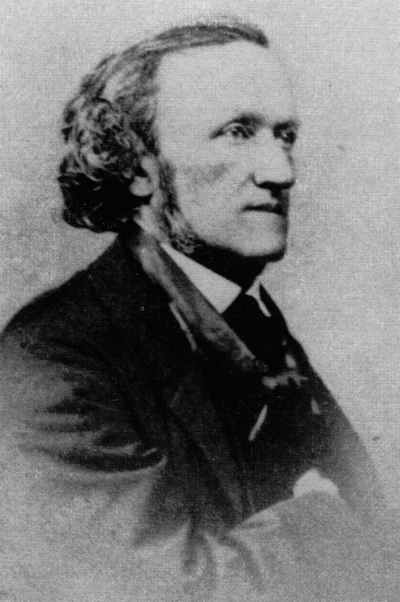
The situation was regularised when Johanna married Ludwig in August 1814, and young Richard was brought up as Richard Geyer. It is impossible to say whether Richard was actually Geyer’s son – it is certainly a possibility. Richard Wagner, in his autobiography Mein Leben (My Life), is remarkably mendacious in glossing over the affair between his mother and Geyer: “How deeply the homeless artist, hard pressed by life and tossed to and fro, longed to feel himself at home in a sympathetic family circle, was proved by the fact that a year after his friend's death he married his widow, and from that time forward became a most loving father to the seven children that had been left behind.”1 But Wagner the autobiographical writer always preferred to give his family background a more respectable interpretation than the facts dictated.
It is in the musical talent of Wagner that true interest in him lies, for there he is not deceptive; to music Wagner certainly gave of his best. His musical genius is universally acknowledged, and remains so today.
Early Dresden
The Wagner family, in fact, seems to have been blessed richly with musical talent. Three sisters and a brother of Richard were to become professional performers, one sister in particular being considered especially vocally gifted. Young Richard himself began learning pianoforte at the age of seven, at the school of Pastor Wetzel just outside Dresden – he was not particularly interested at that stage. His musical interest was to flower much later. A year later, in 1821, he continued his piano studies with Humann, not a man to inspire the boy at all – in fact, Wagner writes quite disparagingly of the man’s dry-as-dust demeanour.
1 Wagner, Richard.
"My Life - Volume 1." Project Gutenberg. 1865-1880, trans.
1911. Project Gutenberg Literary Archive Foundation . 10 Feb. 2006
<http://www.gutenberg.org/catalog/world/readfile?fk_files=13665&pageno=5>
<http://www.gutenberg.org/catalog/world/readfile?fk_files=13665&pageno=5>