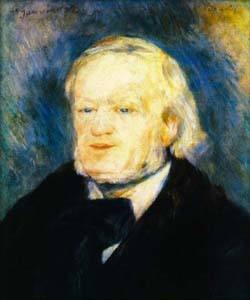
It was only hours later, on 13th February 1883, when Wagner suffered his last heart attack. This one was fatal… and Richard Wagner lay dead in his study, aged 70.
Conclusion
The lasting legacy of Wagner is not so much in his libretti, as in the function of his music, which went through metamorphoses not unbroken by the influences under which he himself changed. Schopenhauer, in one sense, and Liszt, in another sense, helped to shape Wagner’s ideals in opera. Eventually he came to an opinion that neither Italian nor French music had the merit of Germany music, and that music and drama must be entwined as a single unit. His introduction of leitmotifs in opera was much imitated – the sensuality of his music was greatly admired. Pivotal, too, was his use of through-composing, where the music merged seamlessly, one period or section into another.
Chromaticism and romantic melody combined in Wagner’s music, and it attained an almost mystical quality in the fervour of those who admired him. In fact, Wagner’s music and personality became a sharp divider – people loved him or hated him. Debussy, an earlier admirer of Wagner’s music, experienced a revulsion against his magniloquent rhetoric; one of his most famous sayings is that Wagner was “a beautiful sunset mistaken for a dawn”.
Wagner’s fierce nationalism and strong opinions were also instrumental in making him famous, both throughout Germany and beyond.
Perhaps Wagner’s own words, from An End in Paris, form the most fitting conclusion, for they reveal his final reverence for the German ideal and the high pedestal on which he placed Music itself: “I believe in God, Mozart and Beethoven, and likewise their disciples and apostles; – I believe in the Holy Spirit and the truth of the one, indivisible Art; – I believe that this Art proceeds from God, and lives within the hearts of all illumined men; – I believe that he who once has bathed in the sublime delights of this high Art, is consecrate to Her for ever, and never can deny Her; – I believe that through Art all men are saved...”