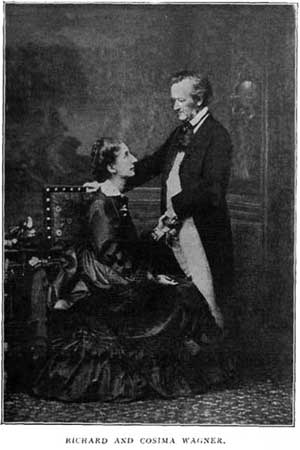
Wagner resumed work on the libretto for Parsifal, and then began work on the music for Act 2 of Siegfried (which had never been fully scored). In June 1865, Tristan und Isolde received its premiere in Munich, but Wagner was not to enjoy his position at Munich for much longer. The scandal he was creating had created so much animosity that Ludwig had little choice but to banish him from Munich in December 1865. By this time, Cosima had already borne Wagner a child, a girl named Isolde. The relationship suffered a hiatus as a result of Wagner’s banishment, but this was of temporary duration.
Banishment and intimacy
Wagner, unwelcome in Munich, departed for his new home supplied by King Ludwig, a mansion called Tribschen, situated on Vierwaldstätter See (known as Lake Lucerne) in Switzerland, where he continued work on Die Meistersinger. On the 25th January 1966, Wagner’s wife Minna died in Dresden, and Wagner was free to marry Cosima – the only thing standing in their way was her own marriage to von Bülow. She bore Wagner a second child, another girl – Eva – in 1867.
Der Meistersinger was finally completed in October 1867, and it premiered in München on 21st June 1868, conducted by none other than the man Wagner had cuckolded, von Bülow. It is certain that von Bülow admired Wagner’s music deeply, whatever he felt about the man himself. (Indeed, his nature was a generous one – he sent a comforting message to his ex-wife upon the death of Wagner years later.) Der Meistersinger was a stunning success, and led Ludwig II to demand the performance of the first two operas in the Ring cycle over Wagner’s strenuous objections.
Ludwig had his way – rehearsals were begun, even while Wagner returned to Tribschen with Cosima late in 1868. Wagner began sketching two new opera librettos in 1868 – Romeo und Julie and Luthers Hochzeit. He resumed work on composing and scoring for Siegfried and Götterdämmerung from 1869 onwards. During this time, Cosima bore Wagner a third child in 1869, a son named Siegfried.
In 1869, the first part of the Ring cycle was performed in Munich, followed the next year by the second part – just as King Ludwig II had wanted, and just as Wagner had not wanted. Being befriended by such a powerful patron as King Ludwig had its drawbacks. One could not display temperament and high offence to a king who was so well able to supply money and opportunity for fame, after all.