Gabriel Knight... there are destinies we cannot avoid

NEWS

NEW Norwegian translation of this site!
NEW “Cat hair moustache” puzzle – full exposé!
NEW Interview with Scott Bilas (technical lead, GK3) by Philip Jong.
NEW Full transcript of Ingrid Heyn’s interview with Robert Holmes.
NEW The Bavaria article is now up.
NEW Yates poem: GK inspiration article is now up.
POSTCARD PETITION GK forum postcard petition to VUG; example text is here on the campaign site.
SIGN Our guestbook is waiting for your signature;
IMPORTANT! How you can help with the GK4 Campaign;
FORTHCOMING Rennes-le-Château; St George; The Templars.

English  ·  Deutsch  ·  Português  ·  Français  ·  Italiano  ·  Русский  ·  Español  ·  Norsk  ·  Česky  ·  ελληνικά  ·  עברית


Richard Wagner

Twilight of an age


Introduction  |  Early Dresden  |  Boy Alone  |  Leipzig schooling  |  Student protests  |  Dorn at first light  |  Counterpoint with Weinlig  |  Wagner as librettist  |  Würzburg  |  Magdeburg  |  Königsberg and marriage  |  Riga  |  The Paris debâcle  |  The Rienzi success  |  Operas in Dresden  |  Political turmoil   |  Switzerland exile  |  The Wesendonck affair   |  The second Paris attempt  |  Marital disaster  |  The Munich scandal  |  Banishment and intimacy  |  The Bayreuth Festspielhaus  |  Heart attacks  |  Conclusion  |  WAGNER'S OPERAS  |


In July 1870, von Bülow finally obtained a divorce from his wife, and Cosima and Wagner were married in Switzerland on the 25th August 1870. Wagner composed the Siegfried Idyll for Cosima that Christmas. Liszt was so stunned at the situation that it led to a life-long estrangement with his daughter.

“Liszt's fatherly love for Cosima, by now his only remaining child, was put to a great test when Cosima decided openly in favour of Wagner, turned Protestant in order to marry him, and, rejecting her French upbringing, embraced Wagner's German nationalism. Cosima's letter to Marie von Schleinitz, which Hamburger includes in the book's appendix, is shocking: Liszt's daughter wanted her father to make her decision known to the humiliated, cuckolded von Bülow, and as he was not willing, Cosima refused to speak to him for years.”7

The Bayreuth Festspielhaus
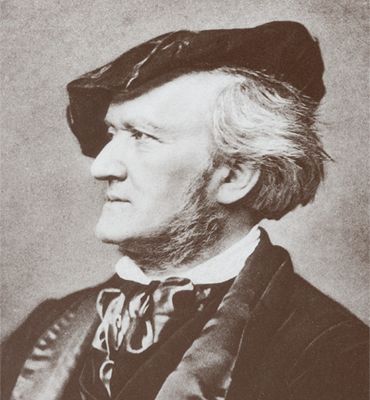
    Richard Wagner
Wagner was back to work in 1871, utterly certain that no existing opera house could do justice to Der Ring des Nibelungen. He convinced King Ludwig that a special festival theatre needed to be built for the purpose – Wagner had long had such a vision in mind, and settled upon Bayreuth as the location. The Bayreuth council was favourable to the idea, and land was donated. In 1872, Wagner laid the foundation stone for what was to be the Bayreuth Festspielhaus, and two years later, the Wagners moved to Bayreuth to a house called Haus Wahnfried, generously provided by King Ludwig. Ludwig also provided the funds for the Festspielhaus.

By 1876, the festival theatre was ready, and the festival performance of Wagner’s Ring cycle took place for the first time in its entirety. But the grand conception by Wagner did not live up to its reception. Der Ring des Nibelungen was not a success – and in fact, Wagner never again heard the cycle performed in Bayreuth. From such a promising beginning came disappointment once again. It is with posterity’s judgement that Wagner’s achievement with this opera house can truly be assessed – for the performance of Wagner’s cycle is one of the major regular events of Bayreuth.
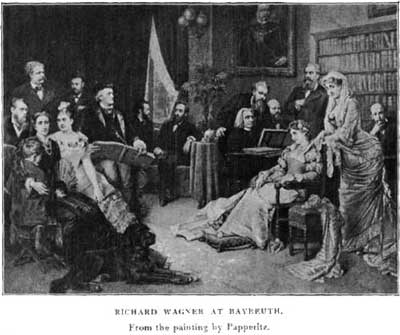
Wagner at Bayreuth    
Wagner continued work after while on what would be his final opera – Parsifal. This had been a long time in the writing. He completed the libretto in 1877, and for the next five years he composed the music. Parsifal is a peculiar work in many ways – it contained bastardised Christian elements, Buddhist elements, and pagan elements, combined to run the risk of offending almost everyone. The work had its premiere on the 26th July 1882.

Heart attacks

Wagner began to show symptoms of ill-health – he was suffering from angina, and more than once he experienced a heart attack. Yet his energy in composing had lost none of its fire, nor had his music become inferior in composition. It was unfortunate, perhaps, that other aspects of his life also remained energetic.


7 Eckhardt, Mária. "Franz Liszt: Lettres à Cosima et à Daniela. Ed. by Klára Hamburger. (Musique- musicologie Series, General Editor Malou Haine), Sprimont, Mardaga, 1996, 238 pp." Hungarian Quarterly. 1996. 10 Feb. 2006
<http://www.hungarianquarterly.com/no146/p146.html>.


Previous page    Next page


Valid XHTML 1.0!    Valid CSS!

 
|  Home  |   Who IS Gabe Knight?   |   The story so far  |   Continue with GK4?  |   How YOU can help  |